
Table of Contents
- Introduction
- 1. Identify High-Paying, Relevant Niches
- 2. Select Top-Performing Offers to Promote
- 3. Build a Value-Driven Content Foundation
- 4. Implement Conversion-Boosting Link Strategies
- 5. Leverage Email and Newsletter Sequences
- 6. Drive Traffic with Social Proof and Creator Tactics
- 7. Optimize, Test, and Scale
- FAQ
- Conclusion
Introduction
Why affiliates matter for revenue
Affiliates drive revenue by connecting audiences with trusted products. They extend reach, help merchants scale, and create performance-based earning opportunities for content creators. You benefit when clicks convert into sales or qualified leads, without the upfront costs of traditional advertising.
In practice, affiliates function as a performance engine. They promote software, services, and offers to engaged readers, earning commissions based on pay-per-sale, pay-per-click, or pay-per-lead models. This alignment of incentives makes the model scalable and measurable.
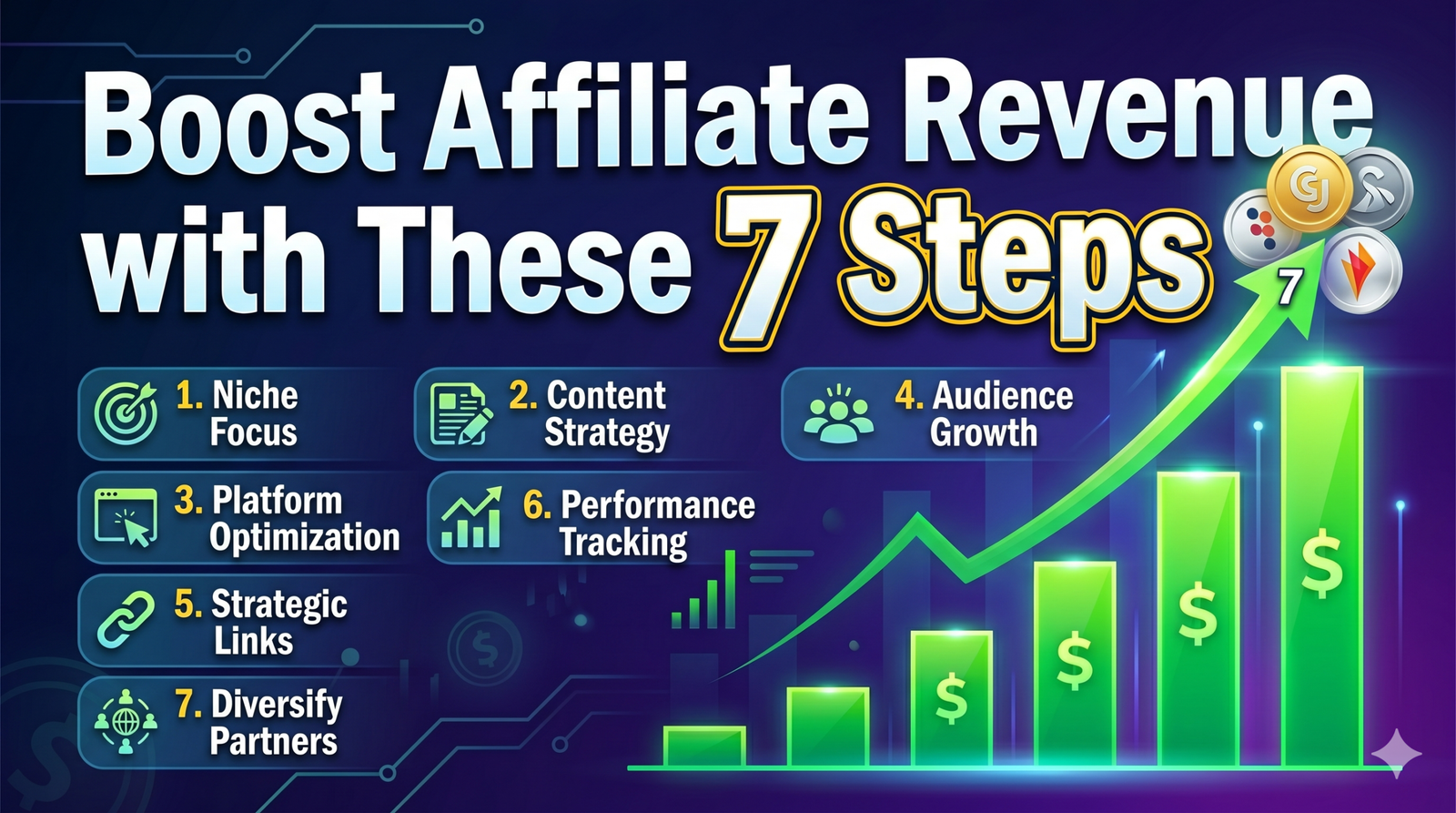
What this 7-step plan covers
This guide lays out seven actionable steps to optimize an affiliate strategy, with a focus on ClickBank opportunities where relevant. You’ll find practical tactics for selecting offers, building content, and improving conversions.
- Identify high-potential niches and offers
- Construct a value-driven content foundation
- Apply conversion-focused link strategies
- Leverage email and newsletters for promotions
- Use social proof and creator collaborations
- Set up robust analytics and testing processes
- Scale campaigns while pruning underperformers
1. Identify High-Paying, Relevant Niches
How to spot lucrative verticals
Begin with programs that offer clear commission structures and reputable merchants. Look for niches where buyers routinely invest in software, ongoing subscriptions, or pay-per-lead deals. Prioritize topics with documented intent signals and repeat purchase potential.
Evaluate marketplace momentum by scanning merchant sites and trend data. Favor niches with frequent product updates, active reviewer communities, and affiliate programs with transparent EPCs. Align with areas your audience already trusts to reduce friction.
- High average order value or recurring revenue
- Active merchant support for affiliates
- Transparent payout tiers and predictable earnings
Assessing product fit and audience demand
Assess how well a product aligns with your audience’s needs. Relevance should translate into higher engagement and conversions. Map product features to common pain points to test fit.
Gauge audience demand using search data, content gaps, and competitive benchmarks. Seek content that answers real questions rather than sales pitches. A solid fit reduces churn and sustains revenue over time.
| Metric | What it tells you |
|---|---|
| Average Commission | Indicative profitability per sale |
| Conversion Signals | Past performance of similar offers |
| Audience Alignment | Relevance to your readers and viewers |
2. Select Top-Performing Offers to Promote
Criteria for choosing dependable programs
Choose programs with clear terms, consistent payouts, and reliable merchant support. Look for stable brands and transparent commission structures. Prioritize offers that align with your audience and show documented performance history.
- Transparent payout tiers and timelines
- Active affiliate support and quick communication
- Recurring or high-value pay-per-sale opportunities
- Relevance to your niche and audience needs
Evaluating converting creatives and payout structures
Assess how creatives are designed to prompt action. Review landing pages, banners, and in-content prompts for clarity and alignment with user intent. Compare payout models to estimate long-term profitability across traffic sources.
- Conversion-friendly landing pages and clear CTAs
- Multiple creatives and formats to test (banners, links, widgets)
- Payout structure clarity including base commissions, bonuses, and payout frequency
| Offer Criterion | What to Look For |
|---|---|
| Commission Type | Pay-per-sale, pay-per-lead, or recurring revenue with predictable margins |
| Payout Thresholds | Low enough to cash out frequently, with reliable processing |
| Creative Quality | Responsive design, tested copy, and clear value propositions |
3. Build a Value-Driven Content Foundation
Creating reviews, tutorials, and comparison posts
Develop content that guides readers through real scenarios. Reviews should highlight practical benefits, limitations, and measurable outcomes. Tutorials demonstrate step by step use cases, while comparison posts contrast options honestly to help readers decide.
Structure each piece with a clear problem statement, solution fit, and concrete results readers can expect. Use screenshots, annotated diagrams, and short video clips when possible to increase clarity. Keep your voice confident and data-backed.
- Reviews that quantify outcomes and include use-case specifics
- How-to tutorials that map to common workflows
- Side-by-side comparisons with objective criteria
Optimizing for intent and search intent signals
Align content with what readers are actively seeking. Map keyword intent to article sections, answering the core questions first. Use clear headings and early value offers to meet readers where they are.
Incorporate intent signals like problem identification, solution details, and actionable steps within the first 300 words. Keep sentences concise and deliver practical insights that readers can apply immediately.
| Content Type | Key Focus | Reader Benefit |
|---|---|---|
| Reviews | Real-world results, pros/cons, benchmarks | Informs purchase decisions with evidence |
| Tutorials | Step-by-step use, workflows, tips | Gets readers to actionable outcomes |
| Comparisons | Feature parity, pricing, trade-offs | Clarifies choices and reduces doubt |
4. Implement Conversion-Boosting Link Strategies
Strategic placement of affiliate links
Place links where readers expect them and where they naturally support decision making. Position links near actionable steps, within comparison details, and after performance data. Avoid clutter, and ensure every link has context that reinforces value.
- Links in reviews where outcomes are quantified
- Positioned near tutorials and how-to sections
- Contextual links in pros and cons lists
Using CTAs, widgets, and in-content prompts
Design concise prompts that align with user intent. Test multiple formats to gauge responsiveness, including inline prompts, banners that match content tone, and contextual widgets that surface related offers.
- Inline CTAs within the body text for relevance
- Widgets that surface complementary offers without overwhelming the page
- A/B tested prompts to identify which phrasing converts best
| Strategy | Best Practice | Impact Metric |
|---|---|---|
| Link placement | Contextual, near decision points | CTR |
| CTA design | Clear action, minimal friction | Conversion rate |
| Widgets | Related offers only | Engagement depth |
5. Leverage Email and Newsletter Sequences
Segmentation for affiliate offers
You can sharpen relevance by grouping subscribers based on their interests, purchase history, and engagement with prior emails. Tailor affiliate messages to match these signals so promotions feel useful rather than pushy.
Segment criteria to consider:
- Interest areas aligned with offers you promote
- Past clicks on related content or product reviews
- Geography or industry if your audience spans multiple verticals
Automated nurture sequences that promote relevant deals
Set up drip campaigns that educate, build trust, and introduce timely offers. Automation helps you stay consistent without sacrificing relevance.
Structure tips:
- Welcome sequence that sets expectations and introduces top offers
- Educational nudges that solve reader problems before pitching
- Deal-centered emails triggered by content consumption or cadence thresholds
| Sequence Element | Purpose | Metric to Watch |
|---|---|---|
| Welcome email | Establish trust and set expectations | Open rate |
| Nurture drift emails | Provide value and soft promos | Click-through rate |
| Offer-focused emails | Promote relevant deals | Conversion rate |
6. Drive Traffic with Social Proof and Creator Tactics
Social proof and testimonies
Social proof builds trust by showing readers real results tied to their own challenges. Highlight concrete outcomes from actual users and connect them to common pain points your audience faces. Use a mix of formats to strengthen credibility.
- Customer quotes tied to measurable results
- Before and after scenarios that illustrate tangible improvements
- Mini case studies from diverse verticals
Collaborations and creator-led promotions
Partner with creators who truly understand your audience. Co-create content that adds value and features relevant offers without heavy selling. Monitor how the creator drives traffic quality and conversion rates.
- Guest reviews on blogs or YouTube channels
- Joint tutorials or comparison videos with transparent results
- Creator-led promotions tied to launches or events
| Tactic | What to Do | Expected Outcome |
|---|---|---|
| Social proof | Show real-user outcomes with specific numbers | Increased trust and click-through rates |
| Testimonials | Use diverse voices from relevant niches | Higher engagement |
| Creator collaborations | Co-produced content with clear relevance | Improved conversions |
7. Optimize, Test, and Scale
A/B testing and analytics setup
Establish a disciplined testing framework to isolate what moves the needle. Test one variable at a time and maintain consistent time windows to reduce noise.
Track core metrics across tests, including CTR, conversion rate, and EPC. Use a centralized dashboard to compare performance on apples-to-apples baselines.
- Test headline variants and lead-in copy to boost engagement
- Experiment link placement and accelerator CTAs for micro-conversions
- Validate creatives and landing pages before large-scale rollouts
Scaling successful campaigns and pruning underperformers
Grow what proves profitable while keeping risk in check. Increase budgets gradually on winning offers and explore adjacent niches that share quality signals.
Remove underperforming assets quickly to protect overall ROI. Reallocate spend to top performers and fine-tune targeting to preserve efficiency.
| Area | Action | Key Metric |
|---|---|---|
| Testing cadence | One variable per test, fixed time window | Statistical significance |
| Scaling | Gradual budget increases on best performers | Return on ad spend |
| Pruning | Cut assets with sustained underperformance | Portfolio win rate |
FAQ
What is the goal of these steps for affiliate marketers? The plan aims to help you surface high value offers, create trusted content, and optimize for revenue across pay-per-sale, pay-per-click, and pay-per-lead models.
Which metrics matter most? Key indicators include click-through rate (CTR), conversion rate, earnings per click (EPC), and payout tier progression. Track these to gauge impact and prioritize improvements.
Do these steps apply to ClickBank offers? Yes, the framework aligns well with ClickBank style programs, focusing on offer selection, content strategy, and conversion-focused optimization.
How often should I review performance? Conduct a formal review monthly, with a lighter weekly check of traffic, clicks, and immediate conversions. Adjust tests and content priorities based on results.
Can I mix channels and formats? Absolutely. Combine blog content, product reviews, video tutorials, and email sequences to reinforce messaging and broaden reach without duplicating effort.
-
- Which niche should I start with? Prioritize niches where your audience shows clear intent and where you can provide unique value or demonstrations of outcomes.
-
- How do I choose dependable programs? Look for stable payout structures, transparent terms, realistic conversion data, and active affiliate support.
-
- What kind of content converts best? Content that answers specific questions, includes practical demonstrations, and connects benefits to user problems.
| Question | Quick Answer | Related Metric |
|---|---|---|
| Which offers to promote? | Top-performing, relevant products with solid commissions | EPC |
| How to measure impact? | Compare before/after metrics using a fixed window for each test | Conversion rate |
Conclusion
You now have a practical seven-step blueprint to boost revenue through affiliate marketing. The plan centers on selecting lucrative niches, choosing dependable offers, and building content that converts across multiple channels.
To keep momentum, implement a 48-hour action plan. Then review results with a simple metric set: CTR, conversion rate, EPC, and payout tier progress. Use a centralized dashboard to spot trends quickly.
- Choose high-potential niches aligned with your audience.
- Promote top-performing offers with clear payout structures.
- Publish value-driven content that answers real questions.
- Position links and CTAs for maximum in-content impact.
- Leverage email sequences to nurture relevant deals.
- Use social proof and creator collaborations to boost trust.
- Test, scale, and prune to improve ROI over time.
Real-world templates help you stay consistent. Use content briefs, outreach scripts, and review post outlines to convert readers into buyers without guesswork.
| Aspect | Recommended Action | Key Metric |
|---|---|---|
| Content strategy | Publish reviews, tutorials, and comparisons | Engagement per post |
| Conversion focus | Strategic link placement and prompts | CTR |
| Measurement | Weekly checks of traffic, clicks, and immediate conversions | Short-term trend |